In February 2025, a Canadian insurance company transferred nearly $12 million after receiving what appeared to be a routine call from their CFO. The voice on the phone matched perfectly. The tone was right. The context of the conversation made sense.
The CFO never made that call. The voice was generated by artificial intelligence, cloned from publicly available audio recordings. By the time anyone realized what had happened, the money was gone (Source: Brightside AI).
This is not a one-off incident. Deepfake voice fraud is hitting organizations across Canada, and the attacks are getting cheaper, faster, and harder to detect. If your organization relies on voice calls to authorize financial transactions or verify identity, you need to understand how this threat works and what to do about it.
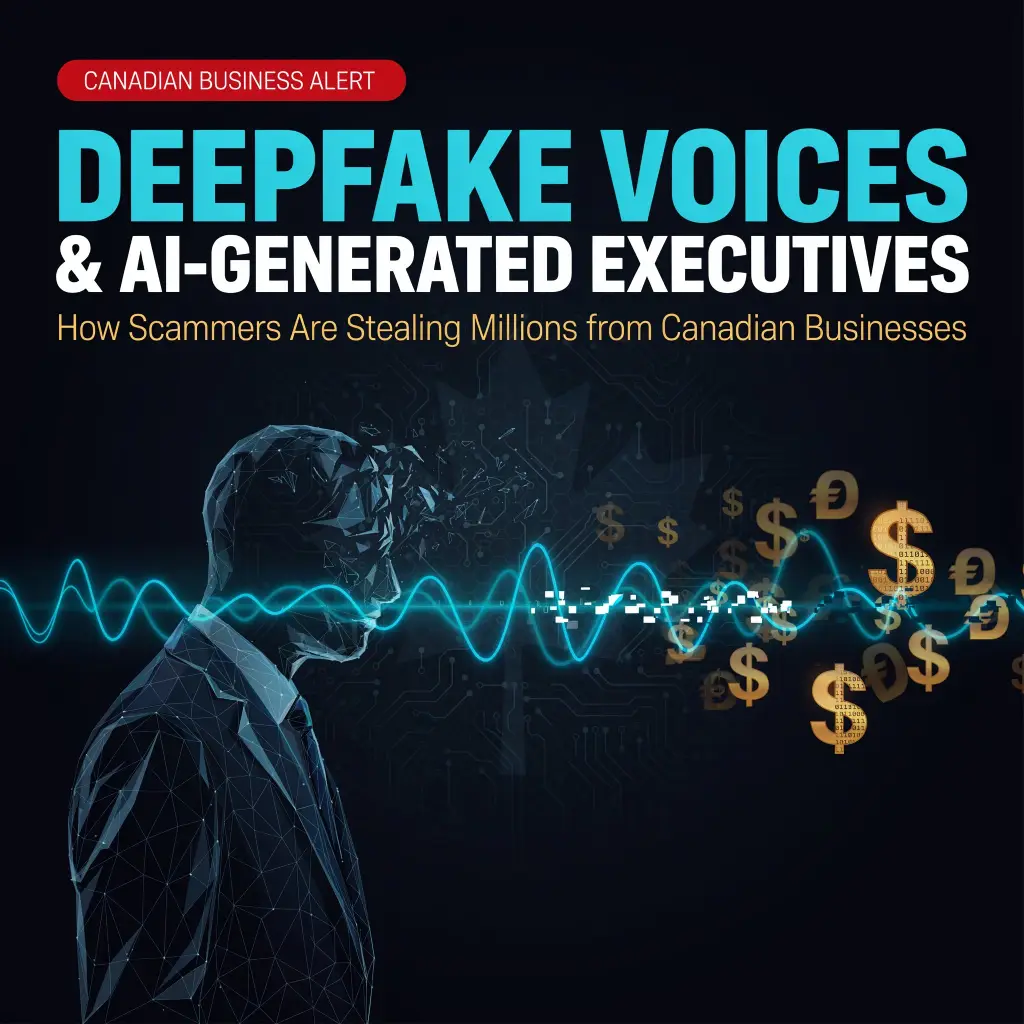
The Canadian insurance case follows a pattern that security researchers are seeing with increasing frequency. The attackers researched the company, identified the CFO, collected voice samples from public sources, and used AI voice cloning to produce a near-perfect replica. The call was placed to a finance team member who had no reason to doubt its authenticity.
This was not the first high-profile case and it will not be the last. In February 2024, engineering firm Arup lost $25 million when a finance worker in Hong Kong was deceived by a deepfaked video call. The attackers did not just clone one voice. They created AI-generated versions of the CFO and multiple other executives, all participating in what appeared to be a live video conference. The finance worker saw familiar faces, heard familiar voices, and received what seemed like a legitimate instruction to transfer funds.
The technology behind these attacks is alarmingly accessible. According to Group-IB, a convincing voice clone can be created from as little as three seconds of audio. Three seconds. That is less than a voicemail greeting, a podcast introduction, or a conference panel clip. If your executives have any public audio presence, attackers already have what they need.
Deepfake voice attacks combine AI voice cloning technology with traditional social engineering. The AI handles the voice. The human attacker handles the strategy.
The process starts with voice collection. Attackers harvest audio from LinkedIn videos, podcast appearances, investor calls, webinars, conference recordings, media interviews, and company marketing materials. Any public audio of a target executive provides training data for the clone.
Modern voice cloning tools process that audio and produce a model that can speak any text in the target’s voice, matching their accent, cadence, and speech patterns. Some tools support real-time voice conversion, meaning an attacker can speak naturally into a microphone and have their words come out in the executive’s voice during a live phone call.
The attack itself combines the cloned voice with detailed research about the organization. Attackers study reporting structures, financial processes, current projects, and recent communications. They know who reports to whom, what projects are active, and when key people are traveling or unavailable. When the cloned voice calls requesting an urgent transfer during the CFO’s business trip, every detail checks out.
Several factors make Canadian organizations particularly attractive targets for deepfake voice fraud.
Executive visibility is high. Canadian business culture encourages executive thought leadership. CEOs and CFOs appear on podcasts, speak at industry events, record LinkedIn videos, and participate in media interviews. Each appearance gives attackers more voice data to work with.
Phone-based verification is trusted. Many Canadian businesses still treat a phone call from a recognized voice as sufficient verification for financial decisions. The assumption that “I know my CFO’s voice” feels reasonable but is now dangerously outdated. Human hearing cannot reliably distinguish between a real voice and a high-quality clone.
Remote and hybrid work reduces in-person confirmation. When the CFO works from home three days a week, employees cannot walk down the hall to confirm an instruction. Remote work normalized voice and video calls as the primary method for high-stakes communication, which is exactly the environment deepfake attacks exploit.
Mid-market companies lack voice verification protocols. Large banks and financial institutions have invested in voice authentication technology. But most mid-market Canadian companies rely on informal verification: “That sounded like our CFO, so it must be our CFO.” This gap in formal verification creates the opening attackers exploit.
The numbers are staggering and accelerating. Global losses from deepfake-enabled fraud reached over $200 million in the first quarter of 2025 alone (Source: deepfake statistics research). Cyble projects that global AI scam losses will reach $40 billion by 2027, with deepfake fraud representing a rapidly growing share of that total.
What makes this threat different from earlier forms of fraud is the democratization of the technology. Cyble documented an explosion of Deepfake-as-a-Service platforms throughout 2025, making voice and video cloning available to criminals with no technical expertise. The cost of launching a deepfake voice attack has dropped to a fraction of what it was two years ago, while the quality has improved dramatically.
For Canadian organizations, the cost of a successful attack extends far beyond the stolen funds. IBM’s 2025 Cost of a Data Breach report puts the average breach cost in Canada at CA$6.98 million, with phishing-related breaches averaging CA$7.91 million. Add reputational damage, regulatory scrutiny, and the cost of internal investigation, and a single deepfake voice attack can cost an organization more than $20 million in total impact.
Defending against deepfake voice attacks requires changing how your organization verifies identity and authorizes transactions. Technology alone is not enough. You need procedural safeguards that assume voice and video can be faked.
Establish callback verification on a separate channel. If you receive a call requesting a financial transaction or sensitive action, hang up and call the person back on a verified number through a different communication channel. If the request came by phone, verify by text or secure messaging app. Never verify a request using the same channel it arrived on.
Implement code word systems for high-value transactions. Assign rotating code words that must be used to authorize transfers above a defined threshold. The code words should be shared only in person or through an encrypted channel that is separate from normal business communication. Change them regularly and limit who knows them.
Require multi-person authorization for large transfers. No single individual should be able to authorize a transfer above your organization’s risk threshold. Dual authorization with independent verification ensures that a deepfake attack on one person cannot result in a completed transaction.
Train employees on voice manipulation threats. Your team needs to know that voice cloning exists, that it is effective, and that recognizing a voice is no longer proof of identity. Training should include real examples of deepfake voice attacks and hands-on exercises with actual voice cloning demonstrations. People need to hear how convincing these fakes are to take the threat seriously.
Deploy technical detection tools. Voice authentication systems that analyze spectral patterns, breathing anomalies, and micro-pauses can flag potential deepfakes. These tools are not foolproof, but they add a detection layer that complements your procedural controls.
Adopt a zero-trust approach to voice-based instructions. Treat every voice-based request for financial transactions, credential changes, or access modifications as unverified until confirmed through an independent channel. This is the same zero-trust principle your network security uses, applied to human communication.
The verification protocols above are essential first steps. But a complete defense against deepfake fraud requires integrating these measures into your broader security program.
Your incident response plan should account for AI-based social engineering scenarios. When a deepfake attack is detected, your team needs to know exactly what to do: who to notify, how to freeze the transaction, how to preserve evidence for law enforcement, and how to communicate the incident internally without creating panic.
Regular security assessments should test your organization’s resistance to voice and video deepfake attacks. Simulated attacks reveal whether employees follow verification protocols under pressure, whether your detection tools catch synthetic voices, and whether your authorization controls hold when tested by a convincing fake executive.
Your identity and access management policies should prevent single-person authorization of high-value transfers and sensitive system changes. IAM policies need to reflect the reality that voice and video identity verification alone are no longer trustworthy. Multi-factor authorization that includes something a deepfake cannot replicate is now a requirement, not a luxury.
How can I tell if a voice on a call is a deepfake?
You probably cannot, and that is the point. High-quality voice clones are indistinguishable from the real person to the human ear. Rather than trying to detect deepfakes by listening, focus on procedural verification. If a call involves a financial transaction, sensitive data, or a change in access permissions, verify the request through a completely separate channel before acting.
Is deepfake voice fraud covered by our cyber insurance?
Coverage depends on your specific policy. Some cyber insurance policies cover social engineering fraud, which deepfake voice attacks fall under. Others exclude losses resulting from voluntary transfers, even if the authorization was obtained through deception. Review your policy language with your broker and ask specifically about AI-generated voice fraud coverage. If it is not explicitly covered, negotiate for it at renewal.
Can deepfake detection software reliably identify fake voices?
Detection tools are improving but remain imperfect. They analyze audio for artifacts that human ears miss, such as unusual spectral patterns, missing micro-pauses, or inconsistent breathing. However, cloning technology is advancing just as quickly. Detection should be one layer in a multi-layered defense, not your only protection.
Should we remove our executives’ audio and video from public platforms?
Completely removing executive audio from the internet is impractical for most organizations. Conference recordings, podcast interviews, and news clips exist on platforms you do not control. Instead of trying to eliminate voice data, focus on building verification protocols that work even when attackers have perfect voice clones. Reducing unnecessary audio exposure helps, but it should not be your primary defense.
What should we do if we suspect a deepfake voice attack is in progress?
Do not hang up immediately. If possible, stall the caller while a colleague independently contacts the person being impersonated through a verified channel. Record the call if your system allows it, as the recording is valuable evidence. Do not process any requested transactions. Notify your security team and follow your incident response plan. Report the attempt to the Canadian Anti-Fraud Centre and your local law enforcement.
The era of trusting a voice on the phone is over. Three seconds of audio is all an attacker needs to clone your executive’s voice, and the tools to do it are available to anyone willing to pay for a subscription. Canadian businesses are losing millions to attacks that exploit a simple assumption: that a familiar voice means a trusted person.
Protecting your organization starts with accepting that voice and video are no longer reliable identity verification methods. Build verification protocols that do not depend on recognizing a voice. Test those protocols with realistic simulations. Make sure your incident response plan addresses AI-powered social engineering.
If you are ready to assess your organization’s vulnerability to deepfake fraud and build defenses that match the threat, contact Brigient. The attackers already have the tools. It is time to make sure you have the defenses.

Written by
Founder & Managing Director, Brigient
Sameer Malik is the Founder and Managing Director of Brigient, a boutique cybersecurity advisory firm based in Mississauga, Ontario. With over 20 years of experience in cybersecurity, governance, risk management, and IT strategy, Sameer has led more than 300 incident and ransomware response engagements for organizations across Canada. He holds a BA from the University of Toronto and is certified in TOGAF® 9 (The Open Group Architecture Framework) and ITIL (IT Infrastructure Library). Sameer's approach to cybersecurity is built on four pillars: Identify, Respond, Recover, and Govern.
Connect on LinkedInLet’s Talk About Your Project: Unleash Possibilities, Explore Solutions, and Forge a Brighter Digital Future Together.
Contact Us Today!