Cybersecurity spending is no longer an IT line item. It is a board level decision that directly affects revenue, valuation, insurability, and regulatory standing. Yet many Canadian executives still treat it as a cost to minimize rather than a risk to quantify.
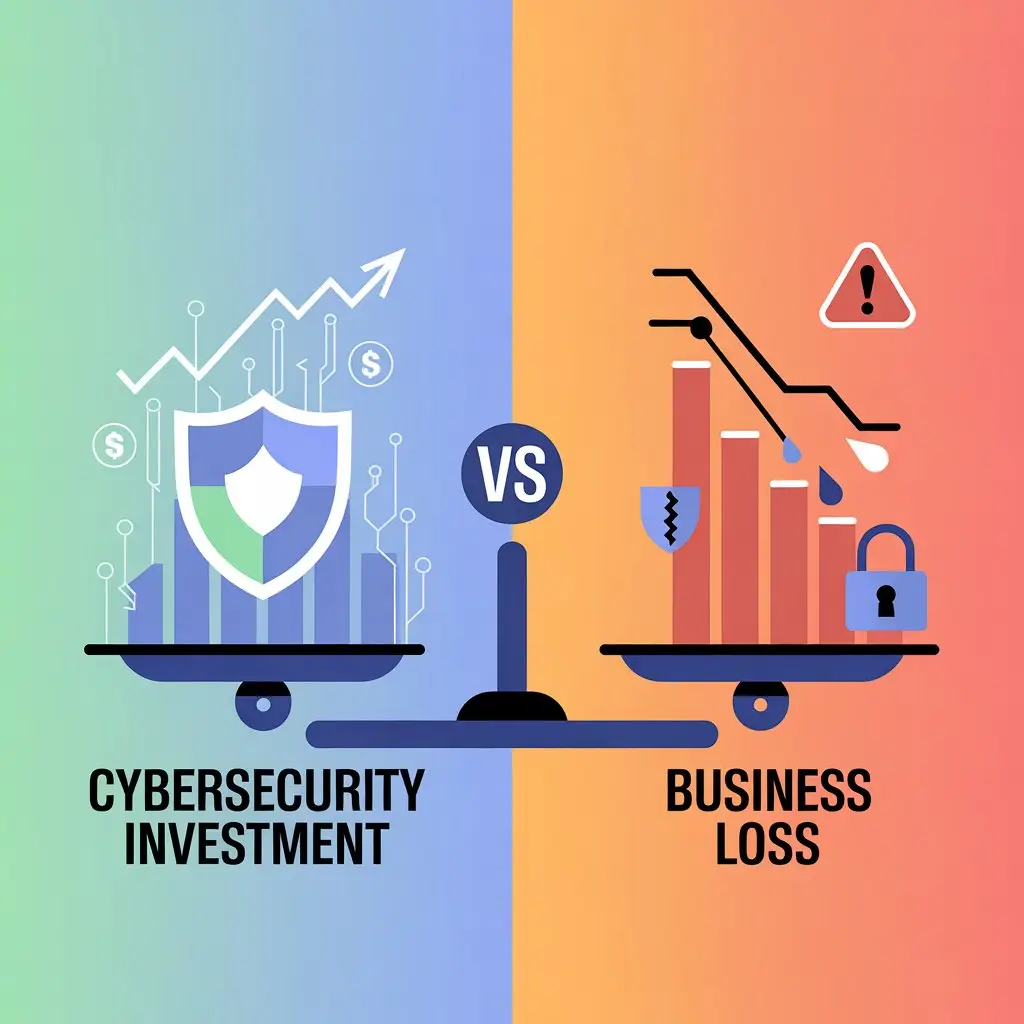
This comparison lays out the real numbers. On one side is the planned, predictable cost of a proper cybersecurity program. On the other side is the unplanned, often catastrophic cost of a single serious breach. When the two are placed next to each other, the financial logic becomes hard to ignore. It is also the exact financial conversation Brigient leads with Canadian clients before recommending a single control. For additional reading on related topics, explore more cybersecurity articles and guides or review real world business cases from recent engagements.
According to the IBM Cost of a Data Breach Report 2024, the global average cost of a data breach reached 4.88 million USD, the highest total on record. In Canada, the average cost sits among the top five countries globally, driven by regulated sectors like finance, healthcare, and technology.
Statistics Canada and the Canadian Centre for Cyber Security continue to report that ransomware, business email compromise, and supply chain attacks are the most common and most expensive threats affecting Canadian organizations. The Sophos State of Ransomware 2024 study found that the average ransomware recovery cost, excluding ransom paid, was 2.73 million USD, a figure that has more than doubled since 2020.
The pattern is consistent. The cost of reacting to a breach is rising faster than the cost of preventing one. That is why a structured cybersecurity program from Brigient frames every engagement around reducing impact and dwell time rather than simply adding tools.
A mature cybersecurity investment is not a single tool purchase. It is a program with recurring operating costs and periodic capital costs. For a typical Canadian mid-market business with 100 to 500 employees, a reasonable annual spend ranges from 1 to 3 percent of revenue, depending on industry and regulatory exposure.
That budget usually funds risk consulting and annual risk assessments, identity and access management (IAM) with multi factor authentication across email, VPN, and cloud consoles, endpoint detection and response (EDR) tooling and monitoring, security awareness training for employees, incident response planning and tabletop exercises, logging, monitoring, and a managed SIEM or SOC capability, governance, policy, and compliance alignment with PIPEDA, SOC 2, ISO 27001, or PCI DSS, and regular penetration testing or adversary simulations.
Brigient packages these controls under a four pillar framework of Identify, Respond, Recover, Govern. The structure keeps spend focused on measurable outcomes and avoids the common trap of buying more tools without reducing risk. This investment is predictable, budgetable, and measurable. It also compounds in value. Every year of operation strengthens detection, response, and governance maturity.
Most executives underestimate breach cost because they only picture the ransom demand or the IT cleanup bill. The real cost is layered and can unfold over 18 to 24 months.
Direct costs include incident response and forensics fees, which typically start at 50,000 USD and reach into the millions for complex cases, legal counsel and privacy regulator engagement, mandatory breach notification under PIPEDA including customer communication and credit monitoring, system rebuild, data recovery, and hardware replacement, and ransom payment if the organization chooses to pay (often not recommended and not always effective). An incident and breach response retainer, such as the kind Brigient offers, is designed to contain many of these costs by engaging qualified responders in hours rather than days.
Downtime during containment and recovery is a primary operational cost. The IBM report shows that breaches with a life cycle beyond 200 days cost an average of 1.76 million USD more than those contained quickly.
Additional operational costs include lost productivity while staff work around degraded systems, emergency overtime for IT, legal, and communications teams, and the cost of engaging external consultants at premium rates during an active incident. Organizations that engage Brigient ahead of an incident and invest in planned recovery capabilities typically spend a fraction of these figures because containment decisions, evidence handling, and recovery sequencing are already documented.
Revenue impact is often underestimated in early budget conversations. A breach can trigger lost sales during outages, customer churn especially in B2B contracts with security clauses, delayed or cancelled deals as prospects request updated security attestations, and contract penalties for failing to meet uptime or data protection service level agreements.
For many mid-market firms, the revenue tail from a single incident exceeds all direct recovery costs combined. A documented program, including the SOC 2 and ISO 27001 alignment work Brigient supports through governance engagements, can also accelerate sales cycles by removing security friction from procurement.
Regulatory and insurance costs are rising the fastest. These include fines and enforcement action from the Office of the Privacy Commissioner of Canada for PIPEDA violations, increased cyber insurance premiums, higher deductibles, or outright non renewal, and loss of certifications such as SOC 2 or ISO 27001 until remediation is verified.
Insurance carriers are also tightening underwriting. Many policies now exclude claims where basic controls like MFA, EDR, and tested backups were not in place at the time of the incident. Brigient helps clients document these controls through a structured cybersecurity program in the language insurers and auditors expect, which is often enough to improve premium outcomes on renewal.
The hardest costs to quantify are the ones that persist long after technical recovery. These include reputational damage tracked in earned media and review sites, executive turnover including CIO, CISO, and CEO changes often seen in public breach cases, class action lawsuits and settlement costs, and difficulty hiring and retaining security talent after a public incident.
These long tail costs can equal or exceed the direct and operational costs combined, but they rarely appear on a single line in a financial report. Governance programs, which are a core part of what Brigient delivers, reduce this exposure by creating defensible records of due diligence long before an incident occurs.
Consider a mid-market Canadian services firm with 250 employees, 60 million CAD in annual revenue, and client data covered by PIPEDA and SOC 2. The comparison between a planned investment and an unplanned breach is illustrative.
This scenario is modeled on publicly available benchmarks from the IBM Cost of a Data Breach Report 2024, Sophos State of Ransomware 2024, and historical Canadian breach disclosures. Actual figures vary by industry, data type, and maturity of existing controls. Brigient uses scenarios like this one in risk consulting engagements to turn vague cyber concerns into a defensible financial model. For examples from comparable firms, review published business cases.
Annual program cost of roughly 600,000 to 1,200,000 CAD, inclusive of tools, staff, and consulting. This covers risk assessment, IAM, EDR, monitoring, awareness training, incident response retainer, and governance support. Over three years, the total cost is approximately 1.8 to 3.6 million CAD.
Outcome: reduced likelihood and reduced impact of incidents, stronger sales enablement due to security attestations, lower insurance premiums, and improved audit readiness. Most importantly, the business retains predictability in both cost and risk posture. This is the shape of a typical Brigient engagement for a firm of this size.
Baseline IT security spend of roughly 150,000 CAD per year, with no dedicated program. A single ransomware or data breach event occurs in year two. Typical realistic cost using IBM and Sophos benchmarks:
Conservative total for a single event: 1.7 to 5.3 million CAD, often paid within a 6 to 12 month window. In almost every realistic scenario, Option A costs less over a three to five year horizon than a single Option B event. Many organizations in this position use an incident and breach response retainer as an immediate first step.
The return on cybersecurity spend is usually measured as risk reduction, not revenue growth. The cleanest way to communicate it to a board is with three simple metrics.
First, Annualized Loss Expectancy reduction. Estimate the probability of a breach without controls (often 20 to 40 percent per year for mid-market firms based on industry studies) and multiply by expected loss. Then estimate the reduced probability with a mature program. The difference is the annual value delivered.
Second, Time to Detect and Time to Contain. According to IBM, organizations that contain a breach in under 200 days save an average of 1.02 million USD compared to slower peers. A program that shortens detection windows pays for itself. Brigient designs every incident response plan around shrinking this window, often validated through adversary simulations.
Third, Insurance and Sales Impact. Companies with documented security programs and certifications regularly secure lower cyber insurance premiums, pass vendor due diligence faster, and win enterprise contracts that require SOC 2 or ISO 27001 status.
Objection: “We are too small to be targeted.”
Reality: Verizon DBIR data shows that small and mid-sized organizations are now the majority of breach victims because attackers automate at scale. Size is not a defense. Most Brigient clients are in exactly this bracket.
Objection: “Our IT team handles security.”
Reality: IT operations and security operations are different disciplines. Asking one team to do both creates coverage gaps during an incident. A consulting partner fills the governance, risk, and response gap without replacing the internal team, which is the delivery model Brigient uses through risk consulting and governance programs.
Objection: “Cyber insurance will cover it.”
Reality: Insurance pays after the loss is incurred and only for covered items. Policies increasingly exclude claims where basic controls like MFA, IAM, EDR, or backups were missing. Premiums also rise sharply after an incident.
Objection: “We cannot justify the budget.”
Reality: The relevant comparison is not budget versus zero. It is planned investment versus worst case loss. When framed as risk transfer and risk reduction, the business case becomes straightforward.
Use a simple five step process in the next leadership meeting.
If the math still feels abstract, a focused risk consulting engagement with Brigient can produce a defensible financial model in a few weeks, along with a prioritized roadmap that maps every recommended dollar of spend to a measurable reduction in exposure. For more perspective on planning and execution, browse additional articles or review recent business cases. When you are ready, contact a Brigient security specialist to turn the comparison in this guide into a plan you can take to your board.
Let’s Talk About Your Project: Unleash Possibilities, Explore Solutions, and Forge a Brighter Digital Future Together.
Contact Us Today!