Cyber insurance has become a common recommendation in risk management conversations, and for good reason. A single ransomware attack or data breach can cost a small Canadian business tens of thousands of dollars in recovery, legal fees, and regulatory fines. Insurance helps cover those costs.
But here is where many business owners run into trouble: they purchase a policy, file it away, and assume they are protected. They are not. Cyber insurance is financial protection after an incident, not a substitute for preventing one. Insurers know this, and their underwriting requirements are getting stricter every year.
This post breaks down what cyber insurance for Canadian small businesses actually includes, what it excludes, and what you need to have in place before a policy will even pay out. Understanding your ransomware risk as a Canadian business is closely tied to what your insurance policy will and won’t cover.
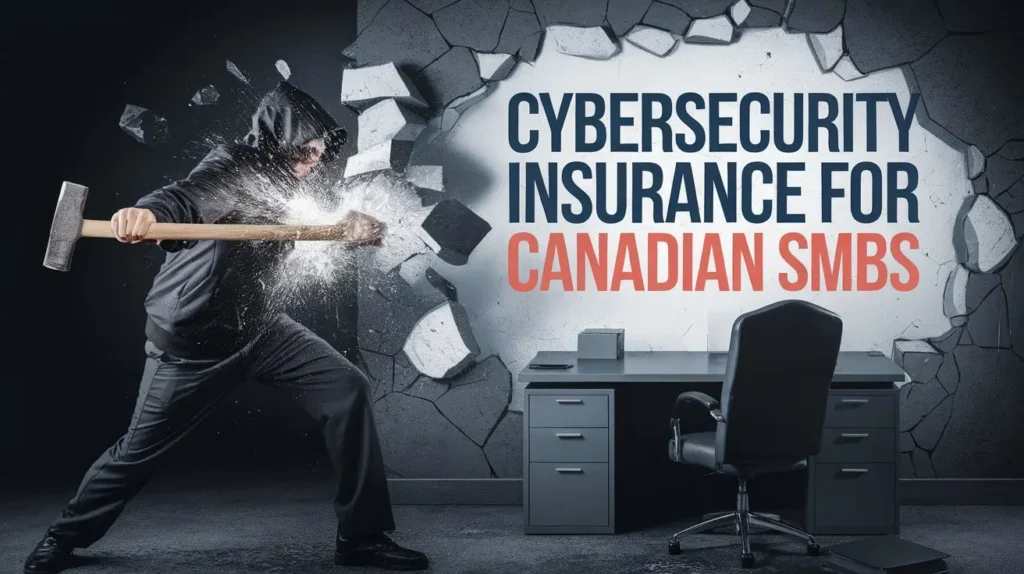
Cybersecurity insurance, also called cyber liability insurance, is a policy designed to help businesses recover from the financial fallout of a cyber incident. Covered events typically include ransomware attacks, data breaches, business email compromise, and system downtime caused by a cyberattack.
According to the Insurance Bureau of Canada, cyber incidents are now among the top risks facing small and mid-sized businesses, yet adoption of cyber insurance among Canadian SMBs remains low. Many owners either assume their general commercial liability policy covers digital incidents — it usually does not — or they believe their business is too small to be a target.
The CIRA 2023 Cybersecurity Survey reported that 25 percent of Canadian organizations experienced a cyberattack that disrupted operations in the previous year. Small businesses are not exempt from that statistic.
Coverage varies by insurer and policy tier, but most cyber insurance policies for Canadian SMBs are structured around two categories: first-party costs (what happens to your own business) and third-party liability (what happens to others because of your breach).
First-party coverage addresses the direct costs your business incurs when an incident occurs. This typically includes:
Notification obligations are not optional in Canada. A single breach affecting a moderate number of customer records can generate significant mailing, call centre, and credit monitoring expenses. Having a documented data breach response plan in place before an incident dramatically reduces both the cost and the chaos when you need to act quickly.
If your business holds client data and that data is compromised, affected parties may pursue legal action. Third-party liability coverage helps pay for:
Third-party claims can be particularly severe for businesses in healthcare, financial services, legal, and any sector handling sensitive personal information. Even a small firm with a modest client base can face disproportionate legal exposure if sensitive records are exposed.
Most modern cyber policies include ransomware coverage, which can include the actual ransom payment, negotiation services, and cryptocurrency transaction fees. Ransomware claims remain the primary driver of cyber insurance losses globally, with Canadian businesses seeing increased targeting in the manufacturing, professional services, and municipal sectors.
It is worth noting that paying a ransom does not guarantee data recovery, and some payment recipients may be sanctioned entities, which creates additional legal risk. Insurers typically require you to contact them before making any payment. Skipping that step can void coverage entirely.
The exclusions section of a cyber policy is just as important as the coverage section. These are the gaps that catch businesses off guard when they need the policy most.
Most policies contain a war exclusion that can be applied to cyberattacks attributed to nation-state actors. This became a prominent issue following the NotPetya attacks, when several insurers denied claims by arguing the attack was an act of war. Courts in multiple jurisdictions have issued conflicting rulings on this.
The practical concern for Canadian SMBs: attribution is rarely clean, and some nation-state tools end up in the hands of criminal groups. If your insurer can argue the attack originated with a state actor, your claim may be disputed. Read the war exclusion language carefully and ask your broker how the policy handles attribution ambiguity.
This is the exclusion that creates the most friction at claims time. If your systems were running known unpatched vulnerabilities at the time of a breach, your insurer may reduce or deny your claim on the basis that you failed to maintain reasonable security practices.
CIRA’s 2023 data found that a significant proportion of Canadian organizations are not consistently applying patches within recommended timeframes. Insurers are aware of this. Many policies now include representations at application time, where you attest that your systems are patched and up to date. If that is not accurate, and a claim arises from an exploited known vulnerability, the misrepresentation can void coverage.
Coverage for social engineering — which includes phishing attacks that trick employees into transferring funds or credentials — varies significantly between policies. Some policies include it under a specific social engineering rider, others exclude it, and some treat it as crime coverage rather than cyber coverage.
Business email compromise (BEC) falls into a similar grey area. An employee receives what appears to be an executive email requesting a wire transfer and completes it. Whether that is covered depends on your specific policy wording. Do not assume it is included without confirming with your broker. Running regular phishing simulations for your team helps reduce this risk before it becomes a claim.
Cyber insurance underwriting has changed substantially over the past three years. Insurers that previously issued policies based on short questionnaires now require documented evidence of security controls. Based on current market requirements, Canadian SMBs applying for cyber coverage should expect to demonstrate:
Businesses that cannot demonstrate these controls are either declined coverage or quoted at significantly higher premiums. The Insurance Bureau of Canada notes that the hardening of underwriting standards reflects the claims experience of the past several years.
Premiums vary based on revenue, industry, data sensitivity, and the security controls you have in place. As a general reference:
Average cyber insurance premiums in Canada increased significantly between 2020 and 2023 due to rising claim frequency and severity. While rate increases have moderated, businesses with weak security postures continue to face higher costs and restricted coverage options. The most effective way to reduce your premium is to reduce your actual risk.
Insurance pays for the recovery. A security program reduces the likelihood you need to use it. This distinction matters because no insurer will cover every loss, and no policy eliminates the operational disruption of a serious incident.
Brigient works with Canadian SMBs to build practical cybersecurity programs that satisfy insurer requirements and reduce actual exposure. That includes helping businesses implement zero trust security principles and access controls, run phishing simulations to measure and improve employee awareness, conduct penetration tests to find vulnerabilities before attackers do, and build incident response plans that hold up when something goes wrong.
Many of Brigient’s clients come to us because their insurer flagged gaps during renewal. Others come after an incident and need help with both the immediate response and the longer-term remediation. Either way, the goal is the same: build the security foundation that insurance assumes you already have.
These are the questions Canadian business owners most commonly ask about cybersecurity insurance.
In most cases, no. Standard commercial general liability (CGL) policies were not designed to cover digital incidents and typically exclude cyber events. A separate cyber liability policy is required. If you are unsure, ask your broker to review your current CGL policy for cyber exclusion language.
There is no federal law requiring Canadian businesses to carry cyber insurance. However, some industries and enterprise clients are beginning to require it as a condition of contracts or vendor relationships. Regulated sectors such as financial services and healthcare may also face pressures from regulators to demonstrate financial resilience against cyber risk.
Misrepresentation on a cyber insurance application is treated seriously. If a claim arises and the insurer finds that you attested to controls you did not have in place — such as MFA or regular backups — the claim can be denied and the policy voided. Applications are a legal document. Answer them accurately and keep documentation of the controls you attest to.
Yes. Cyber insurance is available to businesses of all sizes, and micro-business policies with lower coverage limits have become more common. The qualifying criteria still apply. Insurers will ask about MFA, backups, and basic security practices regardless of company size. A business with five employees that handles sensitive client data carries real cyber risk and is insurable as long as baseline controls are in place.
Cyber insurance is a financial safety net, not a security strategy. The two need to work together, and right now most Canadian SMBs have gaps in one or both.
Brigient helps Canadian small and mid-sized businesses close those gaps with practical, right-sized cybersecurity programs built for organizations without dedicated IT teams. From phishing simulations and penetration testing to risk assessments and incident response planning, Brigient provides the hands-on support that helps businesses qualify for coverage, reduce premiums, and respond effectively when incidents occur.
Visit brigient.com to learn more or to schedule a no-obligation consultation with the Brigient team.
Let’s Talk About Your Project: Unleash Possibilities, Explore Solutions, and Forge a Brighter Digital Future Together.
Contact Us Today!