Two of the most frequently confused services in cybersecurity also happen to be two of the most important. Business leaders in the GTA regularly ask their IT teams or security advisors to ‘do a pen test’ when what they actually need is a threat risk assessment, or vice versa. The confusion is understandable. Both services involve examining your security posture, both produce findings and recommendations, and both get lumped under the broad label of ‘cybersecurity assessment.’
But they answer fundamentally different questions. Getting the wrong one for your situation is like hiring an auditor when you need an architect, or bringing in a contractor to renovate before knowing what your building code requires.
This guide breaks down what each service actually is, what it tells you, and how to determine which one your business needs right now.
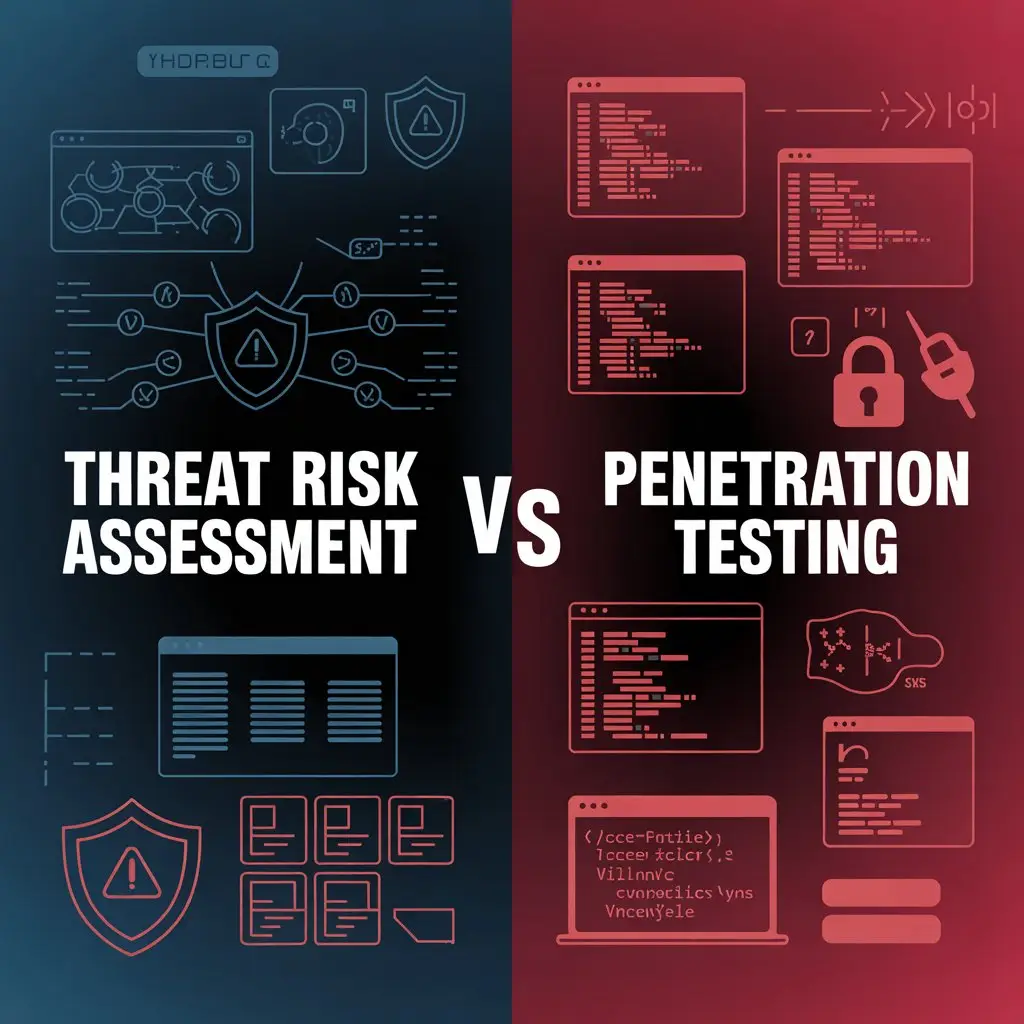
A Threat Risk Assessment (TRA) is a structured process that identifies the risks your organization faces, evaluates the likelihood and potential impact of those risks, and prioritizes them so you can make informed decisions about where to invest your security resources.
A TRA is broad by design. It looks at your people, your processes, your technology, your third-party relationships, and your regulatory environment. It considers threat actors (who might target you and why), threat vectors (how they might attack), and your existing controls (what is already in place to stop them).
The output is typically a risk register: a prioritized list of risks with recommended mitigations, mapped to a framework like NIST CSF, ISO 27001, or the CIS Controls.
A TRA does not involve active exploitation of your systems. It is an analytical exercise, not a live attack. Assessors gather information through interviews, documentation review, technical scans, and data analysis.
This distinction matters because a TRA can be conducted without disrupting your operations. It is appropriate at almost any stage of your security program.
Penetration testing (pen testing) is a simulated cyberattack against your systems, conducted by security professionals who are attempting to find and exploit real vulnerabilities before real attackers do.
A pen tester behaves like an adversary. They probe your network perimeter, attempt to bypass authentication controls, escalate privileges, move laterally through your environment, and document every successful exploitation path they find. The goal is to demonstrate what a real attacker could actually do, not just what might theoretically be possible.
Pen tests are typically scoped to a specific target: your external network perimeter, your web application, your internal network, or a specific system.
A Threat Risk Assessment asks: What are our risks and how serious are they? It is broad in scope (people, process, technology, governance), analytical in method, and outputs a risk register with prioritized recommendations.
Penetration Testing asks: Can an attacker actually exploit our systems? It is narrow in scope (specific systems or environments), technical and active in method, and outputs specific exploitation evidence with remediation steps.
A TRA is your starting point. A pen test is your validation.
A TRA is your starting point if you are building or maturing a cybersecurity program, responding to a compliance requirement, or trying to understand your overall risk profile before deciding where to invest.
Common situations where a TRA is the right choice:
According to the Canadian Centre for Cyber Security, organizations that conduct regular threat risk assessments are better positioned to prioritize security investments and reduce their overall exposure.
Pen testing is a validation exercise. It confirms whether your controls actually work under real attack conditions. It is most valuable when you already have security controls in place and want to know whether they hold up.
Common situations where pen testing is the right choice:
The Verizon 2024 Data Breach Investigations Report found that external actors were responsible for 65% of breaches, with stolen credentials and phishing as the top entry points. A penetration test that focuses on credential-based attacks and phishing simulation can directly validate whether your defenses hold against the most common real-world attack patterns.
If your budget allows for both services, the right sequence is a TRA first, followed by penetration testing.
The TRA identifies your highest-risk areas and helps you prioritize where to focus hardening efforts. Once you have addressed those priorities, a penetration test validates whether the hardening worked. Running a pen test without a TRA first often results in a list of technical findings with no strategic context for prioritization.
For organizations that are more mature and have run multiple cycles, alternating between TRAs (for strategic review) and pen tests (for technical validation) on an annual or semi-annual basis is a reasonable approach.
Red team engagements are often mistaken for penetration tests, but they are more expansive. A red team engagement simulates a full adversary campaign against your organization, including technical attacks, social engineering (phishing, vishing), and sometimes physical security testing.
Red team exercises are best suited for organizations with mature security programs that have already conducted multiple pen tests and are ready to test their detection and response capabilities end-to-end. Brigient’s adversary simulation team designs and executes red team engagements tailored to the specific threat actors most likely to target your industry and organization.
Brigient works with GTA and Toronto-area businesses across both disciplines. For threat risk assessments, the team uses established frameworks (NIST, ISO, CIS) to build a risk register that gives executives and boards a clear picture of where the business stands and what to prioritize.
For penetration testing and adversary simulations, Brigient’s security professionals conduct scoped engagements that produce actionable technical findings tied to real business risk, not just a list of CVEs.
You can explore Brigient’s full service offerings at brigient.com or review related content on the Brigient blog at brigient.com/blog/.
How often should a business in Canada conduct a threat risk assessment?
Most frameworks recommend at least annually, or whenever a significant change occurs in your environment, such as a major technology change, acquisition, new product launch, or shift in your threat landscape. Regulated industries may have specific requirements that mandate more frequent assessments.
How much does penetration testing cost in Canada?
Pricing varies widely based on scope, methodology, and duration. A basic external network pen test for a small-to-medium business might start in the range of a few thousand dollars, while a full red team engagement for a larger organization can be significantly higher. The cost of a pen test is almost always lower than the cost of the breach it might prevent.
Do I need penetration testing to be compliant with Canadian privacy law?
PIPEDA does not mandate penetration testing specifically, but it does require organizations to implement safeguards appropriate to the sensitivity of the personal information they hold. Many organizations use penetration testing as evidence of due diligence in their security safeguard program.
What is the difference between a vulnerability scan and a penetration test?
A vulnerability scan is automated. It identifies known vulnerabilities in your systems but does not attempt to exploit them. A penetration test involves a skilled human tester who attempts to actually exploit vulnerabilities, chain weaknesses together, and demonstrate real-world impact. Scans are faster and cheaper but provide far less assurance than a manual pen test.
Can a small business afford penetration testing?
Yes. Scoped engagements focused on your highest-risk assets, such as your external perimeter or a single web application, are accessible for most small and medium businesses. A qualified provider will help you identify which assets carry the most risk and prioritize accordingly.
The wrong security assessment wastes your budget and gives you false confidence. The right one, properly scoped and executed, gives you a clear picture of where you are exposed and what to do about it.
If you are not sure whether your business needs a threat risk assessment, a penetration test, or a combination of both, Brigient’s team can help you figure that out. Start with a conversation at brigient.com, and get clarity on exactly what your cybersecurity program needs in 2026.
Let’s Talk About Your Project: Unleash Possibilities, Explore Solutions, and Forge a Brighter Digital Future Together.
Contact Us Today!